To landscape a steep block effectively, you need more than just a vision; you need a strategy that respects gravity and local regulations.
Embracing the Slope: A Complete Guide
You know that feeling when you fall in love with the stunning treetop views in Eltham or Doncaster, only to realize the driveway looks like a ski jump? It is a classic trade-off many Melbourne homeowners face.
We have spent years providing steep block solutions that transform these challenging gradients into functional sanctuaries.
Most people see a steep block as a problem to be fixed, but the real opportunity lies in using that elevation to create zones that flat blocks simply cannot offer.
Our team has found that the difference between a money pit and a masterpiece usually comes down to one boring but critical factor: site preparation.
This guide breaks down the exact costs, engineering requirements, and design strategies we use to turn a vertical challenge into your property’s best feature.
Understanding Your Slope
Measuring the Challenge
You need accurate data before drawing a single line.
We always start by determining the “Angle of Repose” for the specific soil type on site.
This engineering term refers to the steepest angle at which your soil remains stable without sliding. In Melbourne’s clay-heavy eastern suburbs, this is often different than the sandy soil found near the bay.
Key metrics to gather include:
- Gradient: The rise over run, expressed as a ratio (e.g., 1:4) or a percentage.
- AHD Levels: Australian Height Datum levels which show the exact height above sea level.
- Fall Direction: This impacts sun exposure and drainage requirements.
- Existing Features: Rock floats, significant trees, and natural water paths.
Common Slope Categories
We use this classification system to determine the machinery and engineering likely required for your project.
| Grade | Classification | Machinery Typically Required | Engineering Impact |
|---|---|---|---|
| 1:10 (10%) | Gentle | Dingo / Mini Loader | Minimal. often exempt from permits. |
| 1:5 (20%) | Moderate | 1.7t Excavator | Retaining walls likely need permits. |
| 1:3 (33%) | Steep | 5t Excavator / Crane Lift | Significant. Structural engineering mandatory. |
| 1:2 (50%+) | Very Steep | Specialist Spider Excavator | Major works. Geo-technical report essential. |
Key Design Principles
Work With, Not Against
The most expensive mistake you can make is trying to force a flat design onto a sloping site.
We encourage a “cut and fill” approach to balance the earthworks.
This technique involves taking soil from the high side (the cut) and using it to build up the low side (the fill). It drastically reduces the cost of carting soil off-site, which can run upwards of $150 per cubic meter for clean fill in Melbourne.
- Follow natural contours to minimize excavation.
- Create organic level changes rather than one massive wall.
- Use the slope to create natural amphitheatres or sunken fire pits.
- Limit soil removal to keep disposal costs down.
Create Usable Spaces
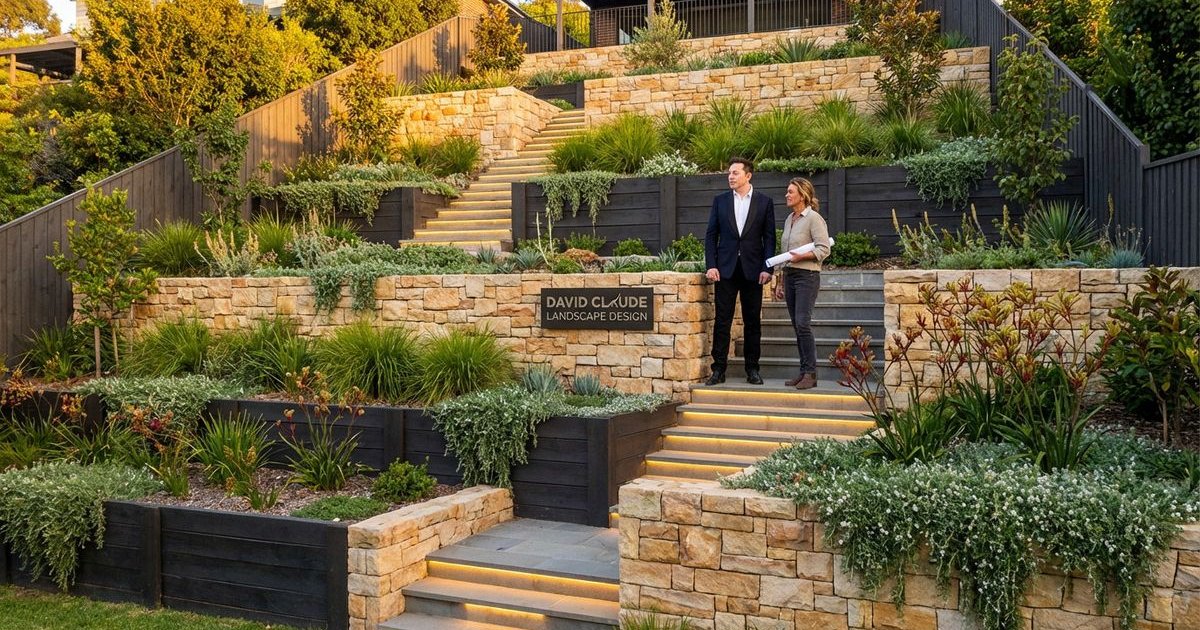
The goal is to carve out flat “rooms” within the incline.
Our designers often terrace the slope into distinct zones:
- Dining Terraces: Located near the house for easy kitchen access.
- Play Zones: Flat lawn areas carved into the mid-section.
- Production Gardens: Veggie patches on the sunniest levels.
- Transit Zones: Steps and ramps that connect the journey.
Manage Water Intelligently
Water is the primary enemy of any steep landscape.
We have seen entire banks collapse because surface runoff was ignored.
You must control where the water goes during a 1-in-100-year storm event, not just a light shower.
- Surface Runoff: Use swales (shallow channels) to redirect water away from structures.
- Groundwater: Clay soils hold water, creating immense pressure behind walls.
- Erosion: Exposed soil on a slope will wash away in the first heavy rain.
- Silt Pits: Install these accessible pits to catch debris before it blocks your underground pipes.
Retaining Wall Options
Timber Sleeper Walls
Best for: Walls up to 1.0m in natural, rustic settings.
Construction
- Posts: Galvanized steel H-beams (more durable than timber posts).
- Sleepers: 75mm or 100mm H4 treated pine (or H5 for critical structural use).
- Drainage: 100mm Ag pipe at the base is non-negotiable.
- Backfill: Free-draining scoria or blue metal gravel.
Pros
- Most affordable option ($300-$450 per sqm).
- Easy to install in tight access areas.
- Flexible enough to handle minor ground movement.
Cons
- Finite lifespan (15-20 years max for timber).
- Can warp or bow if not engineered correctly.
- Not suitable for supporting building loads.
Natural Rock Walls
Best for: Large changes in height in bushland areas like Warrandyte.
Construction
- Materials: Local Mudstone or Basalt boulders.
- Technique: “Keying” stones together using gravity and friction.
- Batter: The wall leans back into the slope (usually 1:4 batter).
Pros
- Surprisingly cost-effective ($220-$250 per sqm for lower walls).
- Lasts a lifetime with zero maintenance.
- Provides habitat for local lizards and wildlife.
Cons
- Requires a large “footprint” due to the batter angle.
- We cannot build these vertically; they must slope back.
- Needs heavy machinery to place the rocks.
Concrete Sleeper Walls
Best for: Tight spaces requiring vertical strength and longevity.
Construction
- Posts: Heavy-duty steel I-beams concreted deep into the ground.
- Sleepers: Reinforced concrete panels (patterned or plain).
- Engineering: Almost always requires a structural computation.
Pros
- Extremely durable and rot-proof.
- Thinner profile than rock walls (maximizes yard space).
- Available in woodgrain or stacked stone finishes.
Cons
- Industrial look if plain sleepers are used.
- Higher material cost ($450-$850 per sqm installed).
- Steel posts may rust if near saltwater pools or coastal areas.
Rendered Masonry Walls
Best for: Modern, high-end homes where aesthetics are paramount.
Construction
- Core: Besser blocks (concrete masonry units) with steel rebar.
- Fill: Core-filled with concrete for mass and strength.
- Finish: Acrylic render, often painted or texture-coated.
Pros
- Clean, architectural lines match modern architecture.
- Can integrate lighting, bench seats, and water features easily.
- Permanent structural solution.
Cons
- Most expensive option ($550-$850+ per sqm).
- Requires concrete footings and curing time.
- Prone to cracking if the foundation moves even slightly.
Drainage: The Non-Negotiable
Why Drainage Matters
Poor drainage causes 90% of retaining wall failures in Melbourne.
Our team places a drainage outlet behind every single wall we build.
When clay soil gets wet, it expands and becomes heavy, pushing against your wall with tonnes of force. If that water cannot escape, the wall will eventually lean or snap.
Essential Drainage Elements
Behind Retaining Walls
- Ag Pipe: Use 100mm slotted pipe (not the cheaper 65mm) socked in geofabric.
- Drainage Blanket: A layer of scoria or gravel at least 300mm wide behind the wall.
- Geofabric: This filter cloth prevents soil from clogging the gravel and pipe.
- Legal Discharge Point: You must connect this system to the stormwater, not just let it run into the neighbour’s yard.
Surface Drainage
- Swales: Grassy depressions that guide water safely.
- Channel Drains: Strip drains installed in paved areas.
- Silt Pits: Mandatory maintenance points to clean out sediment.
Groundwater Management
- Cut-off Drains: Intercept water flowing from the property above you.
- Subsoil Drainage: Herringbone patterns of pipe under lawn areas.
Construction Considerations
Access for Machinery
Steep sites are notorious for difficult access.
We often have to use specialized “tight access” equipment like 1.7-tonne excavators or track-mounted barrows.
If a machine cannot drive down the side of your house, costs increase significantly. You might need to budget for:
- Crane Lifts: Hoisting an excavator over your house ($1,500+ per lift).
- Hand Excavation: Manual labour is slow and expensive (approx $80-$100/hr).
- Conveyors: Belts to move soil out to the street.
Staging and Sequencing
You must build in the correct order to avoid painting yourself into a corner.
- Clear & Stabilize: Remove weeds and install temporary silt fences.
- Rough Grading: Bulk excavation to set the levels.
- Retaining Construction: Always build from the bottom of the hill up.
- Drainage Install: Lay pipes before backfilling walls.
- Hardscapes: Paving, decking, and stairs.
- Planting: The final layer to lock the soil in place.
Engineering & Permit Requirements
Victoria has strict rules for modifying terrain.
Our project managers handle the permit process, but you should know the triggers:
- Height: Any wall over 1 metre requires a Building Permit.
- Proximity: Walls closer to a boundary than their height often need permits.
- Surcharge: Any wall supporting a driveway or building needs engineering.
- Overlays: Check for Manningham’s Erosion Management Overlay (EMO) or similar council restrictions.
Planting Steep Sites
Stabilisation Planting
Plants are your long-term erosion control policy.
We select species with dense, fibrous root systems that act like a net holding the soil together.
Tube stock (small plants) is actually better for slopes than advanced pot sizes. Younger plants establish their root systems faster and adapt better to the harsh conditions of a slope.
Effective Species for Melbourne
Native Groundcovers
- Creeping Boobialla (Myoporum parvifolium): A fast-growing carpet that suppresses weeds.
- Kidney Weed (Dichondra repens): Perfect for shady, damp corners.
- Native Violet (Viola hederacea): Great for binding soil in low-traffic areas.
Mass Planting
- Tanika (Lomandra longifolia): Indestructible and drought-tolerant.
- Blue Flax Lily (Dianella revoluta): Excellent for binding clay soils.
- Tussock Grass (Poa labillardieri): Adds softness and movement.
Screening and Structure
- Coastal Rosemary (Westringia fruticosa): Withstands wind and sun exposure.
- Bottlebrush (Callistemon varieties): Attracts birds and tolerates wet feet.
- Australian Fuchsia (Correa varieties): hardy shrubs for understory planting.
Planting Methods
- Jute Matting: Biodegradable matting pinned to the slope prevents soil washing away while plants establish.
- Pocket Planting: Digging individual flat shelves for each plant rather than tilling the whole slope.
- Mulching: Use mulch that knits together (like pine mulch) rather than chips that will float away in rain.
Costs and Budgeting
Budget Factors
Steep block landscaping costs 20-40% more than flat sites.
We find the variance comes from the “hidden” costs: logistics, engineering fees, and specialized labour.
Typical Ranges (2025/2026 Estimates)
| Element | Budget Indication (Installed) |
|---|---|
| Timber Sleeper Wall | $300 - $450 per sqm |
| Concrete Sleeper Wall | $450 - $850 per sqm |
| Rock/Boulder Wall | $220 - $350 per sqm |
| Rendered Block Wall | $550 - $900+ per sqm |
| Excavation & Earthworks | $100 - $200 per cubic metre |
| Engineering & Permits | $2,500 - $4,000 per project |
Value Engineering
If the quotes are coming in high, we recommend these adjustments:
- Switch Materials: Use rocks instead of rendered blockwork for a 50% saving.
- Reduce Walls: Use planted batters (slopes) instead of vertical walls where space permits.
- Stage the Works: Do the hard structural work now and plant it out yourself later.
Professional Help
When You Need It
You cannot DIY a structural retaining wall.
We strongly advise engaging a Registered Building Practitioner (RBP) for any wall over 1 metre or any site with complex drainage issues.
Risks include voiding your home insurance and liability for damage to neighbours’ properties.
Finding the Right Help
- Local Experience: Do they know the difference between Nillumbik mudstone and Boroondara clay?
- RBP Status: Are they registered for structural landscaping?
- Portfolio: Ask to see photos of steep projects completed 5 years ago (to see how they settled).
Your steep block could become your garden’s greatest feature. Contact us to discuss how we can transform your challenging site into something extraordinary.